Color Field Painting: Art History 101 Basics

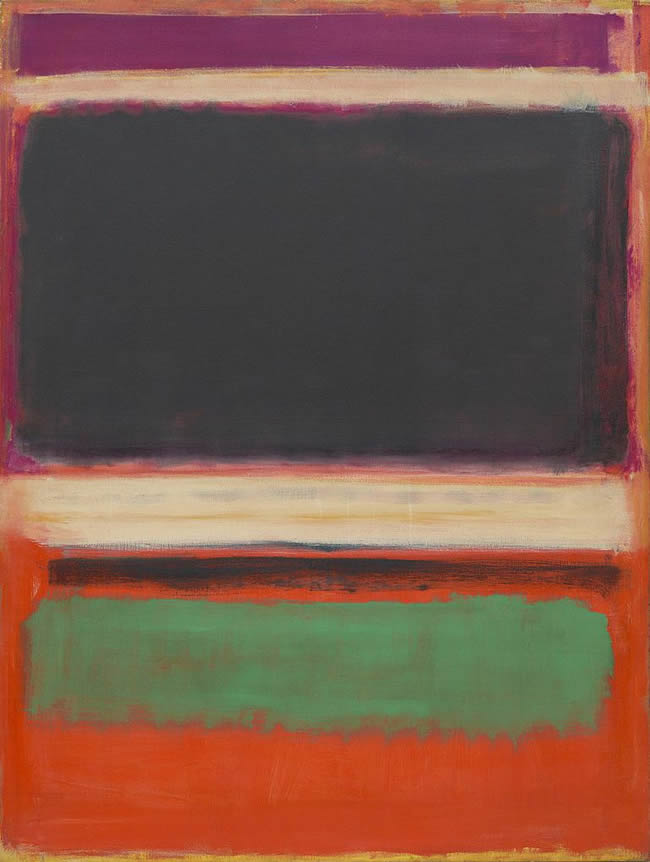
Color Field Painting is part of the Abstract Expressionist family of artists (a.k.a., the New York School). They are the quieter siblings, the introverts. The Action Painters (for example, Jackson Pollock and Willem de Kooning) are the loud siblings, the extroverts. Color Field Painting was called "Post-Painterly Abstraction" by Clement Greenberg.
Color Field Painting and Action Painting have the following in common:
However, Color Field Painting is less about the process of making the work, which is at the heart of Action Painting. Color Field is about the tension created by overlapping and interacting areas of flat color. These areas of color can be amorphous or clearly geometric. This tension is the "action" or the content. It's more subtle and cerebral than Action Painting.
Often Color Field Paintings are huge canvases. If you stand close to the canvas, the colors seem to extend beyond your peripheral vision, like a lake or an ocean. These mega-size rectangles require letting your mind and eye leap right into the expanse of red, blue or green. Then you can almost feel the sensation of the colors themselves.
Color Field owes a great deal to Kandinsky in terms of philosophy but does not necessarily express the same color associations. The best known Color Field Painters are Mark Rothko, Clyfford Still, Jules Olitski, Kenneth Noland, Paul Jenkins, Sam Gilliam and Norman Lewis, among many others. These artists still use traditional paintbrushes and also the occasional airbrush.
Helen Frankenthaler and Morris Louis invented Stain Painting (allowing the liquid paint to seep into the fibers of an unprimed canvas. Their work is a specific kind of Color Field Painting.
Hard-Edge Painting may be considered a "kissing cousin" to Color Field Painting, but it is not gestural painting. Therefore, Hard-Edge Painting does not qualify as "expressionist," and is not part of the Abstract Expressionist family. Some artists, such as Kenneth Noland, practiced both tendencies: Color Field and Hard-Edge.
Color Field Painting began around 1950, following the initial shock of the Action Painters. Helen Frankenthaler, as I write this, is still with us, so that means Color Field Painting is alive--and hopefully well, too.
Anfam, David. Abstract Expressionism.
New York & London: Thames and Hudson, 1990.
Karmel, Pepe, et al. New York Cool: Painting and Sculpture from the NYU Collection.
New York: Grey Art Gallery, New York University, 2009.
Kleeblatt, Norman, et al. Action/Abstraction: Pollock, de Kooning and American Art, 1940-1976.
New Haven: Yale University Press, 2008.
Sandler, Irving. Abstract Expressionism and the American Experience: A Reevaluation.
Lenox: Hard Press, 2009.
Sandler, Irving. The New York School: The Painters and Sculptors from the Fifties.
New York: Harper and Row, 1978.
Sandler, Irving. The Triumph of American Painting: A History of Abstract Expressionism.
New York: Praeger, 1970.
Wilkin, Karen, and Carl Belz. Color as Field: American Painting, 1950-1975.
Washington, DC: American Federation of the Arts, 2007.
