Get Your Head in the Clouds! How To Paint a Realistic Watercolor Sky


When you're painting a landscape or a seascape, keep your eye on the sky. Sunny, stormy, cloudless or hazy, the sky can play a supporting role in your composition, or it can be the most riveting element.
Since the sky changes so often, in such an infinite number of ways, let's focus on one version for this lesson. We'll practice on a cloudy sky, but you can use these tips to paint any kind of sky.
A few tips to get you started:
For this painting, I used a medium-sized round brush and three colors: cobalt blue, Naples yellow and cadmium red.
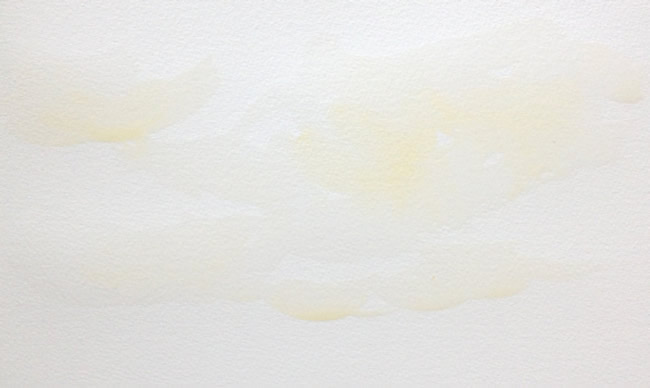
First, wet the paper and wait until it absorbs the water a little. When the surface is still damp but no longer glossy, you'll have more control over the painting process.
Apply a few big, watery brushstrokes of Naples yellow, defining the position of the clouds. It might be easier to do a preliminary contour drawing, but I felt like improvising in this painting. If you want to sketch the clouds first, make sure to keep the lines very light.
Note: It helps to use a watercolor pencil to make a subtle preliminary cloud sketch, so the lines disappear as you paint.
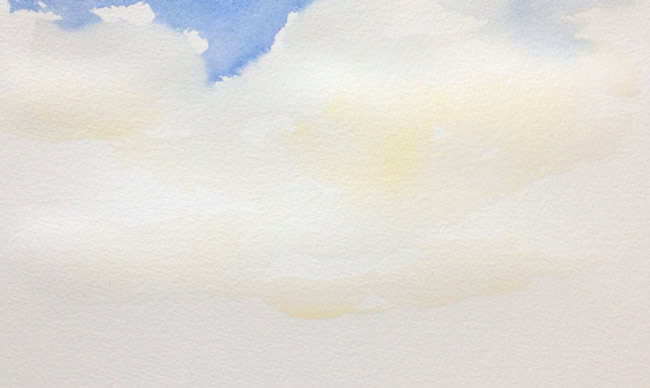
Load up the brush with lots of liquid cobalt blue and start painting the top edge of the clouds. Keep your brushstrokes effortless and spontaneous by using the flat side of the brush instead of the tip.
By this time, my paper was almost dry on top, so the edges came out sharp. I gently softened some of them with a damp brush, leaving some hard edges here and there.

Continue to paint the blue sky, defining the undersides of the clouds, along with some distant clouds and the horizon line.
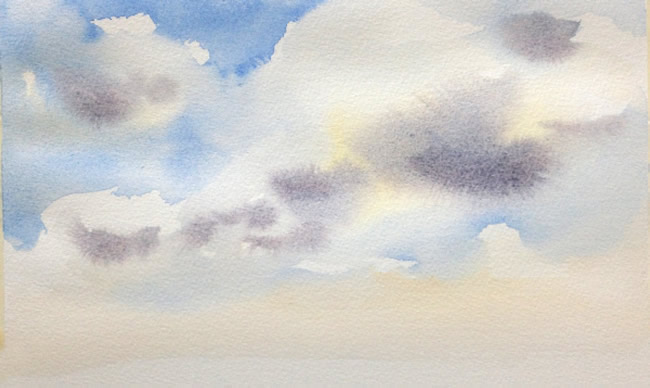
Now that the paper is still wet in the clouds area, it's time to paint some shadows. Add a few light brushstrokes, using a mixture of cobalt blue and cadmium red.

Keep adding shadows and softening edges with the flat side of your brush. I also painted the ground with quick, large brushstrokes, using the mixture of cobalt blue and Naples yellow.

When the sky was done, I added some details in the foreground to give the painting a finished look.
Looking carefully at lots of paintings of skies gives you ideas and helps you refine your technique. Here are more examples of clouds I painted using ultramarine blue, alizarin crimson and Naples yellow.
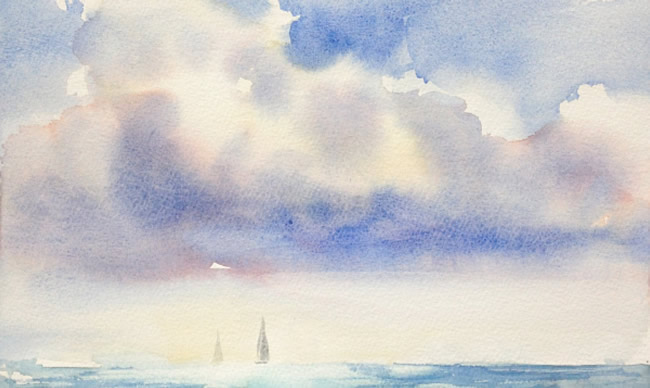
The painting above expresses a calm and peaceful mood. The one below, not so much.
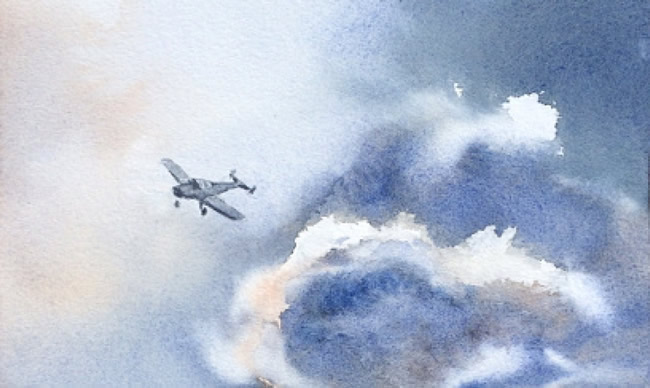
I wanted to convey a stormy, turbulent sky. Combining rich, intense darks with strong value contrasts creates a sense of drama.
Those are only two of the infinite kinds of skies you can paint. Remember, the sky is the limit —or better yet, there's no limit at all.
