How to Make Your Own Coloring Book: Tips and a Tutorial


Let's be real: you don't have to be a kid to love coloring. Adult coloring books are super hot, and for good reason — not only do you have a beautiful piece of art when you're finished, but you feel great, too! (A 2017 study found that coloring reduces stress and anxiety, while also encouraging perseverance.)
So really the question is, why are you not coloring? If it's just that you haven't found the right coloring book, try making your own. DIY'ing a coloring book is easier than you might think and only adds to the creative process. Here are some pointers!
Before you start drawing your pages, you've gotta do a little planning. First and foremost: determine how big your coloring book will be. You can make it any size you want, but it's easiest to keep it 8.5"x11" so you can easily scan and print the pages from your home.
Make sure to think about alignment, too. It might be a bit jarring for someone to flip through your coloring book and have a mash of vertical and horizontal images. Try to make each picture align either vertically or horizontally.
This is where you have all the artistic freedom. Find a theme that inspires you and start designing your pages. (If you're struggling with what to draw, check out some inspo from the cool artists in Doodle Wars .)
For your first coloring book, keep it simple. Start by designing about five pages so you can practice putting a book together. You don't have to immediately launch into a 50-page beast.
Your book can showcase anything you want — from nature scenes to food to abstract mandalas . We decided to do a rainbow theme, with each page a different ROY G. BIV color. Here are a few of the pages to get you inspired:
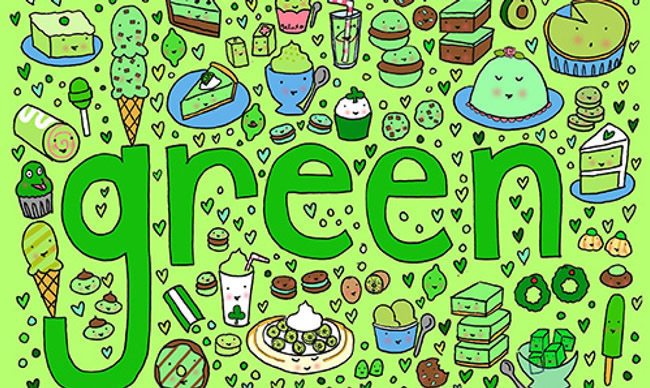
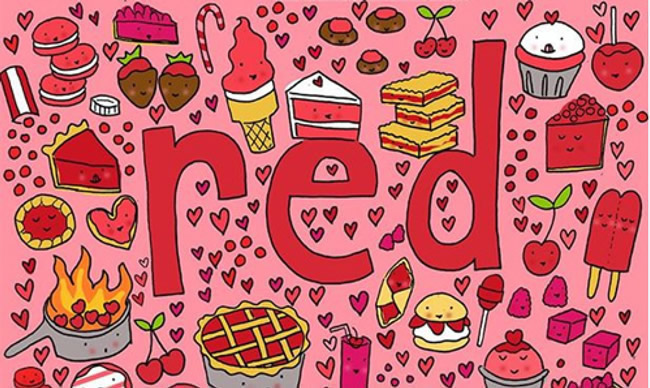
With the digital colors removed, the black and white outlines make a great coloring book pages!
If you know you're going to be using markers to color your pages, don't make 'em double-sided, because that heavy pigment will show through. You might even leave a white page in between each image, just in case.
The medium you plan to use for coloring also makes a difference for your designs. For example, are you going to be using watercolors or colored pencils? This will affect how you make your lines and how big or small you leave your spaces. For watercolor, you'll want keep designs simple, with room to breathe. Colored pencils or markers can be much more precise for coloring in finer details.
Once you've got your designs mapped out, it's time to start drawing and building your coloring book.
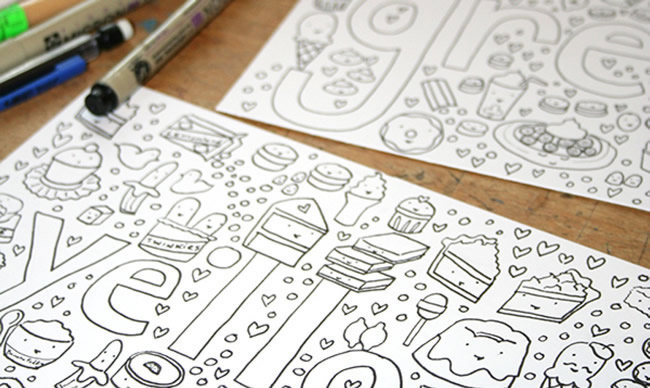
Coloring books feature bold, black-and-white pages. For this reason, if you're working by hand, a large tip pen or a black marker is ideal for creating your images. The pages can also be drawn digitally, if you prefer that method.
If your coloring book has a certain order the pages should go in (like my rainbow book), make sure to include a page number so you can keep the assembly straight.
If you're a confident artist, you can draw your pages freehand. But many of us will prefer to start with a pencil sketch to help establish the composition and layout before making it permanent. Once you're satisfied with a sketch, add ink on top. Then just erase any pencil lines that are showing through. Work page-by-page until you have a handful of finished images.
Once your pages are finalized, it's time to scan 'em. If you stuck with working on 8.5"x11" paper, your computer will easily format the scan to a printable page. If you used a different size, you might have to do a little photo editing.
Print out your pages, making sure they're all the same size. If needed, trim the pages if there's a lot of excess white space around the sides. Organize the pages so they're in the order you want.

This step is technically optional, but adding a cute cover is the best way to tie your coloring book together! Design a page just like you did before, scan and print.
This doesn't have to be high tech. In fact, it's easy to bind your book together using only a needle and thread. For a detailed step-by-step, refer to our binding tutorial .
Now your book is ready to go. Happy coloring!
Photos via Unicorn Love .
