Inside the Winsor & Newton Paint Factory

01
of 07
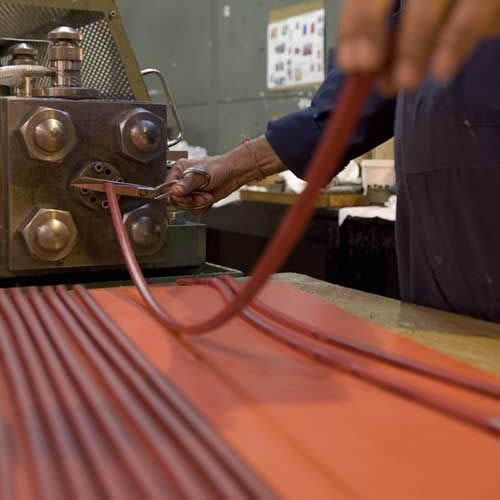
Photo tour of the Winsor & Newton Factory where artists' paint was manufactured.
A tour of the Winsor & Newton factory in west London provided a fascinating look into how the paints we use were made. A colorful mixture of high-tech and low-tech, all ending in the familiar tubes or pans of paint we use in our studios. (The W&N London factory closed in 2012 and production moved to France.)
The watercolor paint we ultimately buy as individual pans gets extruded in long strips before being segmented and plopped into the more familiar, little white plastic pans by machine.
02
of 07
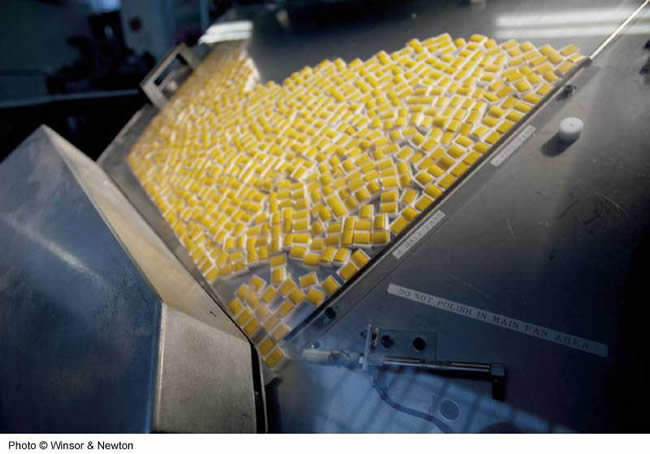
Individual paint colors are manufactured in small runs, but even part of a batch of watercolor pans on the production line still looks like a lifetime's supply for an individual!
03
of 07
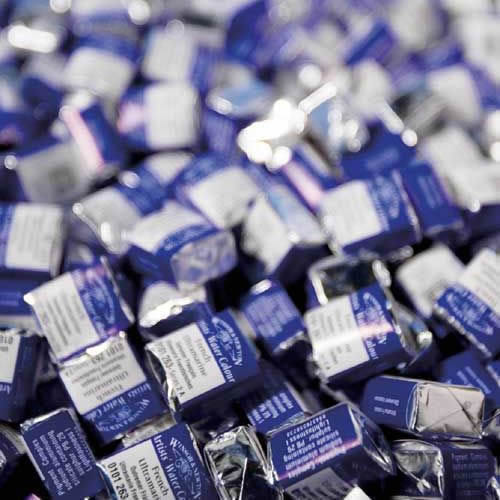
Individual pans of Winsor & Newton's artist's quality watercolor are wrapped in foil and a label added, a process apparently evolved from bubble-gum wrapping machinery. Each plastic pan has the name of the color stamped on it too, useful for checking a color when it comes to replacing it as who ever keeps the wrapper?
04
of 07
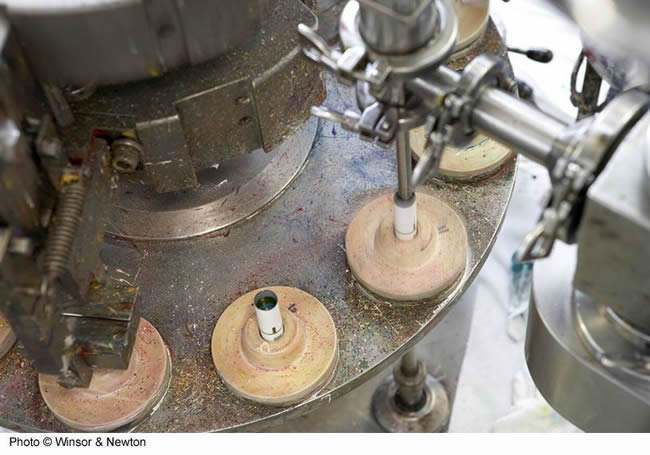
Empty paint tubes are filled with a measured quantity of paint, then the open end (the "bottom" end, not the cap end) folded over and sealed.
05
of 07
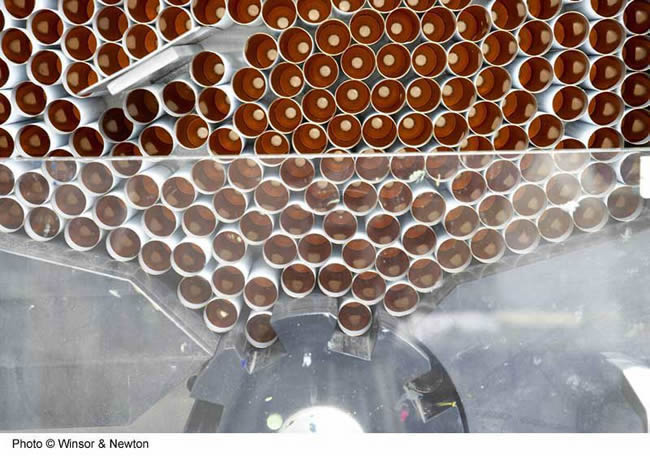
Empty paint tubes on their way to being filled with paint. The smaller, lighter circle you can see in the tube is the inside of the screw-on cap. The inside of the tubes are coated, except for the very end bit which gets folded over and sealed.
06
of 07
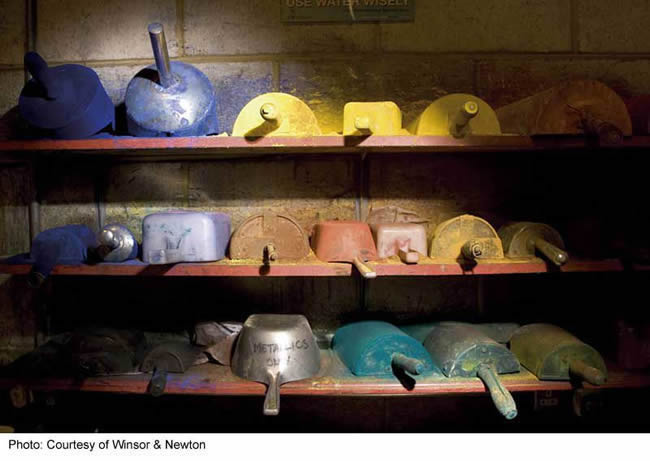
In order to prevent cross-contamination, different scoops are used for measuring out quantities of paint pigment. When a specific paint color is due to be made, an "ingredients list" is sent to the supplies store, specifying how much of what pigment is required for that paint batch.
07
of 07
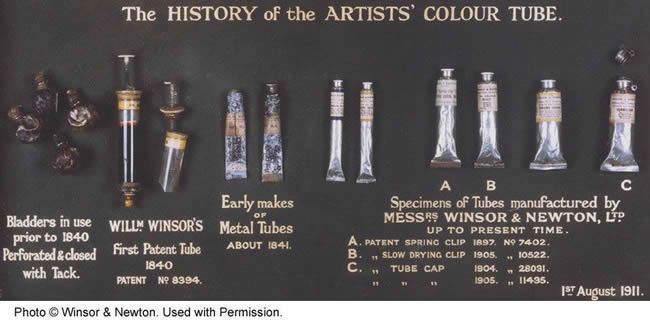
In the small museum on art materials at the Winsor & Newton factory in London, one of the displays is about the invention of the paint tube. Buying paint in a tube is something we take for granted these days, being able to reach out and instantly have some fresh paint in however many colors we have bought. In fact, the squeezable tube with a screw-on lid is the one thing invented for art materials that found its way into everyday life. Think about how many things come in this container, toothpaste, ointments and creams, even food pastes.
Originally artists made up their own paint (or, rather, the studio apprentice did) using the pigments they bought. The first ready-made paint was sold by colormen in pig's bladders, which you punched a hole in to get the paint out and then sealed with a tack. The next invention was a glass syringe, with the plunger squeezing the paint out, invented by the English artist James Hams in 1822. Then in 1841 the American portrait painter John Goffe Rand invented the squeezable or collapsible metal tube.
"My invention related to a mode of preserving paints and other fluids by confining them in a close metallic vessels so constructed as to collapse with slight pressure and thus force out the paint or fluid contained therein... a screw-cap as is show, by which means the fluid contained can be from time to time removed and the end c closed air-tight by the cap." -- John G Rand's patent for the invention of the paint tube
Famous Inventions A to Z
