Jacob Lawrence Biography

The Basics:
"History Painter" is an appropriate title, although Jacob Lawrence himself preferred "Expressionist," and he was certainly best-qualified to describe his own work. Lawrence is one of the best known 20th-century African-American painters, along with Romare Bearden.
While Lawrence is often associated with the Harlem Renaissance, it's not accurate. He began studying art half a decade after the Great Depression terminated the heyday of that movement. It can be argued, though, that the Harlem Renaissance brought into being the schools, teachers and artist-mentors from whom Lawrence later learned.
Early Life:
Lawrence was born on September 7, 1917 in Atlantic City, New Jersey.After a childhood marked by a series of moves, and the separation of his parents, Jacob Lawrence, his mother and two younger siblings settled in Harlem when he was 12. It was there that he discovered drawing and painting (on discarded cardboard boxes), while attending an after-school program at Utopia Children's Center. He kept up painting when he could, but was forced to drop out of school to help support the family after his mother lost her job during the Great Depression.
His Art:
Luck (and the persistent help of sculptor Augusta Savage) intervened to procure Lawrence an "easel job" as a part of the W.P.A. (Works Progress Administration). He loved art, reading and history. His quiet determination to show that African Americans, too, were a major factor in the history of the Western hemisphere -- despite their conspicuous absence in art and literature -- led him to embark on his first important series, The Life of Toussaint L'Ouverture.
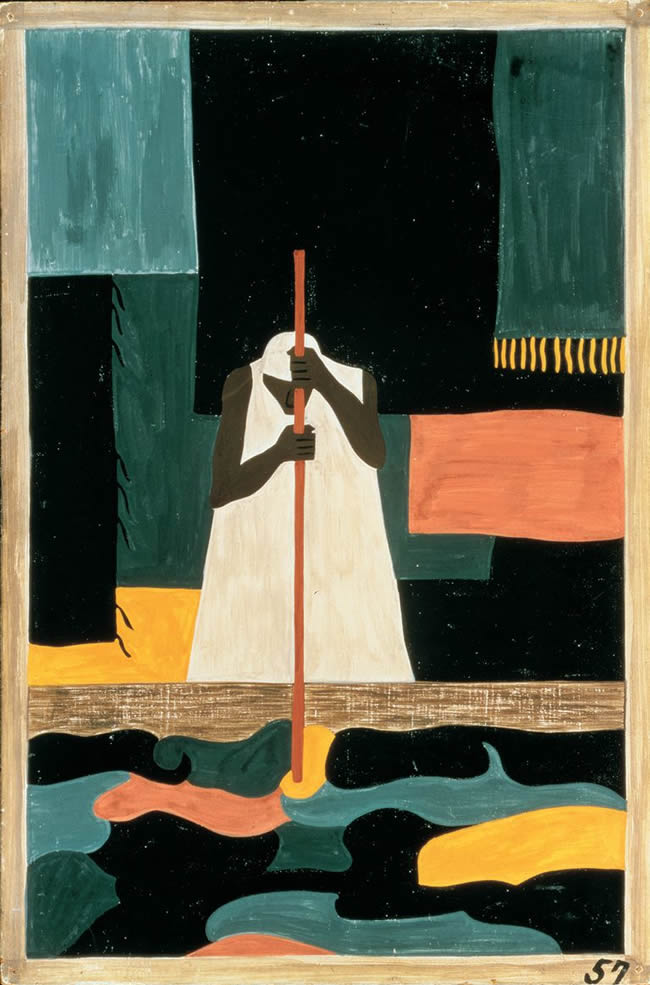
1941 was a banner year for Jacob Lawrence: he broke the "color barrier" when his seminal, 60-panel The Migration of the Negro was exhibited at the prestigious Downtown Gallery, and also married fellow painter Gwendolyn Knight. He served in the U.S. Coast Guard during WWII and returned to his career as an artist. He landed a temporary job teaching at Black Mountain College (in 1947) at the invitation of Josef Albers -- who became both an influencer and friend.
Lawrence spent the rest of his life painting, teaching and writing. He is best known for his representational compositions, full of simplified shapes, and bold colors and his use of watercolor and gouache. Unlike nearly any other modern or contemporary artist, he always worked in series of paintings, each with a distinct theme. His influence, as the visual artist who "told" stories of the dignity, hopes and struggles of African Americans in American history, is incalculable.
Lawrence died on June 9, 2000 in Seattle, Washington.
Important Works:
Famous Quotes:
Sources and Further Reading:
Films Worth Watching:
.
