Explore the History of Pop Art: 1950s to the 1970s

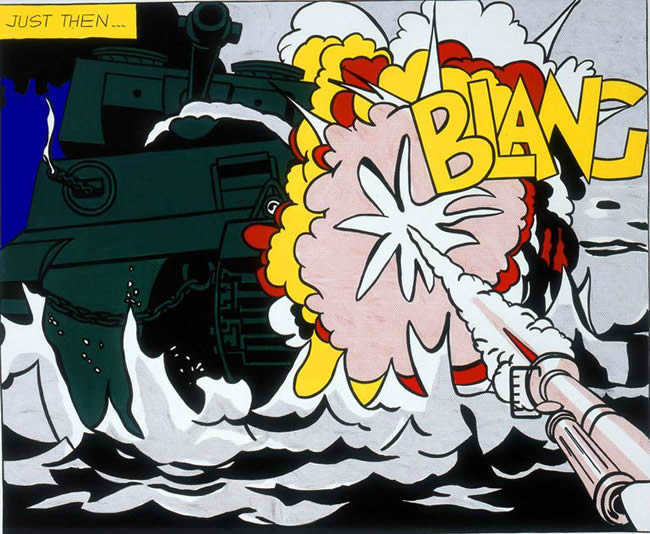
Pop Art was born in Britain in the mid 1950s. It was the brain-child of several young subversive artists - as most modern art tends to be. The first application of the term Pop Art occurred during discussions among artists who called themselves the Independent Group (IG), which was part of the Institute of Contemporary Art in London, begun around 1952-53.
Pop Art appreciates popular culture, or what we also call “material culture.” It does not critique the consequences of materialism and consumerism; it simply recognizes its pervasive presence as a natural fact.
Acquiring consumer goods, responding to clever advertisements and building more effective forms of mass communication (back then: movies, television, newspapers and magazines) galvanized energy among young people born during the Post-World War II generation. Rebelling against the esoteric vocabulary of abstract art, they wanted to express their optimism after so much hardship and privation in a youthful visual language. Pop Art celebrated the United Generation of Shopping.
The movement was officially christened by Lawrence Alloway in his article "The Arts and Mass Media," Architectural Record (February 1958). Art history text books tend to claim that Richard Hamilton's Just What Is It that Makes Today's Home So Different and So Appealing? (1956) signaled that Pop Art had arrived on the scene. The collage appeared in This Is Tomorrow at Whitechapel Art Gallery in 1956, so we might say that this work of art and this exhibition mark the official beginning of the movement, even though the artists worked on Pop Art themes earlier in their careers.
Pop Art, for the most part, completed the Modernist movement in the early 1970s, with its optimistic investment in contemporary subject matter. It also ended the Modernism movement by holding up a mirror to contemporary society. Once the postmodernist generation looked hard and long into the mirror, self-doubt took over and the party atmosphere of Pop Art faded away.
The integration of fine art and popular culture (such as billboards, packaging and print advertisements) began way before the 1950s. Gustave Courbet's (1855) symbolically pandered to popular taste by including a pose taken from the inexpensive print series called Imagerie d’Épinal which featured moralizing scenes invented by Jean-Charles Pellerin. Every schoolboy knew these pictures about of street life, the military and legendary characters. Did the middle class get Courbet's drift? Maybe not, but Courbet did not care. He knew he had invaded "high art" with a "low" art form.
Picasso used the same strategy. He joked about our love affair with shopping by creating a woman out of a label and ad from the department Bon Marché Au Bon Marché (1914) may not be considered the first Pop Art collage, but it certainly planted the seeds for the movement.
Marcel Duchamp pushed Picasso's consumerist ploy further by introducing the actual mass-produced object into the exhibition: a bottle-rack, a snow shovel, a urinal (upside down). He called these objects Ready-Mades, an anti-art expression that belonged to the Dada movement.
Early Pop artists followed Duchamps' lead in the 1950s by returning to imagery during the height of Abstract Expressionism and purposely selecting "low-brow" popular imagery. They also incorporated or reproduced 3-dimension objects. Jasper Johns' Beer Cans (1960) and Robert Rauschenburg's Bed (1955) are two cases in point. This work was called "Neo-Dada" during its formative years. Today, we might call it Pre-Pop Art or Early Pop Art.
Independent Group (Institute of Contemporary Art)
Young Contemporaries (Royal College of Art)
Andy Warhol understood shopping and he also understood the allure of celebrity. Together these Post-World War II obsessions drove the economy. From malls and to People Magazine, Warhol captured an authentic American aesthetic: packaging products and people. It was an insightful observation. Public display ruled and everyone wanted his/her own fifteen minutes of fame.
Lippard, Lucy with Lawrence Alloway, Nicolas Cala and Nancy Marmer. Pop Art.
London and New York: Thames and Hudson, 1985.
Osterwald, Tilman. Pop Art.
Cologne, Germany: Taschen, 2007.
Francis, Mark and Hal Foster. Pop.
London and New York: Phaidon, 2010.
Madoff, Steven Henry, ed. Pop Art: A Critical History.
Berkeley: University of California, 1997.
