Relieve Stress and Anxiety by Creating Art

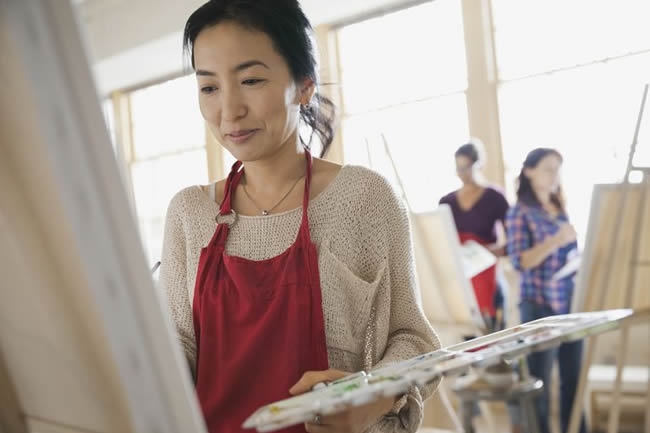
What can one do to help alleviate stress and anxiety? If you’re an artist, keep creating art, for one. Even if you’ve never considered yourself an artist, now is the time to take up an artistic pursuit like drawing or painting. It is never too late, and everyone can do it. If you can hold a brush or crayon or marker, you can draw and paint. And it doesn’t have to be a big investment - a few acrylic paints or a set of watercolor paints, brush, markers or crayons, and paper are all you need, along with some old magazines, a glue stick, and scissors for collage if you'd like. You will be greatly rewarded emotionally, physically, and spiritually for your creative efforts. As Pablo Picasso once said, "Art washes from the soul the dust of everyday life."
Art has been in existence since the dawn of humankind. Using the elements of art and design - line, shape, color, value, texture, form, and space - to make meaning out of life and express a personal vision is an innate impulse. Children do it as soon as they have the fine motor skills necessary to hold a crayon. Through this impulse, artists express the joys, sadnesses, traumas, fears, triumphs, beauty, and ugliness of life. Artists are truth tellers. That is why artists are often perceived as a threat and the first to be censored during times of war and strife.
But being authentic and telling the truth is transformative, both for individuals and groups, and that is the medicinal power of art. Creating art is healing not only for the mind and spirit but also the body since all are interconnected. It works on multiple levels to not only relax but also to restore and rejuvenate, bringing joy and increasing your energy and enthusiasm for life.
As Shawn McNiff writes in Art Heals: How Creativity Cures the Soul, " ...healing through art is one of the oldest cultural practices in every region of the world," and "Art adapts to every conceivable problem and lends its transformative, insightful, and experience-heightening powers to people in need." (1)
Many studies have shown the therapeutic benefits of making art. It is a meditative practice, putting you in “the zone”, with many of the same benefits of meditation, helping you to take your mind off of daily struggles and issues, lowering your blood pressure, pulse rate, and breathing rate, and making you mindful of the present moment.
Making art allows you to play, giving you the freedom to explore and experiment with new techniques, materials, and methods, while also helping to stimulate new brain synapses. An article in Scientific American reports that one of the ways to increase your intelligence is to seek novelty. "When you seek novelty, several things are going on. First of all, you are creating new synaptic connections with every new activity you engage in. These connections build on each other, increasing your neural activity, creating more connections to build on other connections—learning is taking place." (2)
Making art enables you to feel and express gratitude by helping you to observe and see beauty where others may not. It also gives you an outlet for expressing some of your anger and frustration, as well as your personal political and world views.
Art can help you discern feelings and express thoughts that are difficult to articulate. Engaging with the arts and creating something is a way of engaging with and being in a relationship with yourself, helping you to know yourself better. The process of creating art opens channels of communication beyond those of the purely verbal, dissolving barriers caused by words or our own internal censors, helping us to see ourselves, and others, more fully and clearly. In so doing it connects us more deeply to ourselves and to each other. If you are working in class with other people the atmosphere becomes one in which there is a mutual give and take of ideas and a spirit of generosity. The creative process helps to create new relationships and foster existing ones in a positive productive environment.
While art therapy is a distinct field and art therapists are trained and educated in both art and psychology, you don't have to consult a licensed art therapist to reap the benefits of making art, for it is not about the product, it's about the process, and you are the best judge of how the process is affecting you. Although the process is of primary importance, the finished product is a visual reminder of the process and the lessons learned and can stimulate your mind and soul anew each time you view it.
If you don't know how to begin, here are some ideas and resources for ways you can start to create art. You will find that once you start, your creative energies will be unleashed and one idea will lead to the next or even several others. That is the beauty of creativity - it grows exponentially. If you can set aside at least a desk or small area with your art supplies where you can be creative, that will help enormously.
Tip: Play music that energizes or soothes you. Music is a wonderful accompaniment to making art.
REFERENCES
