Artists in 60 Seconds: Tezuka Osamu 手塚 治虫

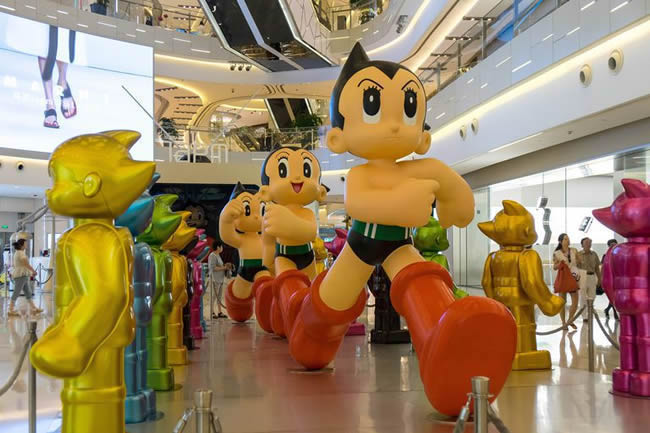
Depending on where you look or who's talking, you'll see Tezuka referred to as the God, Father, Godfather, Grandfather, Emperor and/or King of both manga and anime. ("Manga" and "anime," then - remember those two types of art.)
Whichever of these titles you wish to give the man, it is wholly deserved. He didn't "merely" change the future of manga and create anime as we know it, he worked ceaselessly. Over the course of his career, Tezuka created and wrote more than 700 manga series containing an estimated 170,000 pages of drawings, and another 200,000 pages of anime storyboards and scripts.
November 3, 1928, Toyonaka, Osaka Prefecture, Japan
The eldest of three children, Osamu was born into a family of doctors, lawyers, and military men. His father was an engineer, but had drawn manga prior to marriage, kept a large library of manga and bought a movie projector that would introduce Osamu to two major artistic influences: the animators Walt Disney and Max Fleischer. According to family accounts, his parents were strict disciplinarians but also supportive and encouraging of their children's interests. When young Osamu showed an affinity for drawing, they kept him supplied with sketchbooks.
His parents were also forward-thinking and, as a result, Osamu attended a progressive school where classes were co-ed. He was a bright student who excelled in composition and won popularity with his classmates for his manga sketches and picture cards (which they circulated amongst themselves).
When he was nine, Osamu used his drawing and newly-formed writing skills to produce his first multi-page manga. By age eleven, he was wearing his trademark black-rimmed glasses and had solidified a lifelong interest in insects. He also began using the pen name "Osamushi," a play on words between his name and an insect's.
Despite many other activities (acting and playing the piano, for two examples) he pursued through school and beyond, Tezuka continued to draw. After nearly losing both arms to an infection as a teenager, though, he decided to also study medicine. Due to a severe shortage of doctors in occupied Japan, Tezuka, then 17, was admitted to the medical school of Osaka University in 1945. He was qualified to practice medicine by 1952 and successfully defended his doctoral thesis in 1961. These were noble goals and testify to his keen intelligence. Tezuka's heart, however, was more given to visual art than it was to science.
Shortly after entering medical school Tezuka sold his first comic strip, a four-panel serial called Diary of Ma-chan to an Osaka children's newspaper. Though it appeared in limited circulation, the strip proved popular enough to generate publisher interest in the artist. In short order, he sold the manga The New Treasure Island, the first in a long line of his adaptations from Western literature.
Treasure Island made Tezuka nationally famous and proved to be the tipping point in his career. Even while completing medical school, he published manga at a furious clip, graduating to larger newspapers and reader numbers.
From 1950 until his death, Tezuka worked non-stop. It seemed natural to him to transition his manga characters into the animation he so loved, and thus a genre was born. Even he could not have foreseen that his Astro Boy would take anime global and offer Tezuka international fame. Ever the workaholic, he produced nearly 500 anime episodes -- and this while continuing to conceive, write and draw volumes of some 700 different manga titles.
Tezuka's enduring impact on Japanese popular culture - indeed, on world popular culture - is nearly impossible to overstate. He was truly an exceptionally influential artist.
See pictures of Tezuka Osamu's work in the Special Exhibition Gallery Tezuka: The Marvel of Manga.
February 9, 1989, Tokyo, Japan; of stomach cancer. His posthumous Buddhist name is "Hakugeiin Denkakuenju Shodaikoji."
(Note: This is the Japanese styling, family name first and given name second. If you'd prefer to say the artist's name Western-style, simply switch the order of the two words.)
Sources and Further Reading
