Leonardo, Michelangelo & Raphael: Art of the Italian High Renaissance

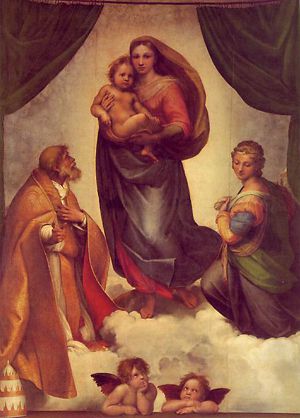
Simply put, the High Renaissance period represented a culmination. The tentative artistic explorations of the Proto-Renaissance, which caught hold and flowered during the Early Renaissance, burst into full bloom during the High Renaissance. Artists no longer pondered the art of antiquity. They now had the tools, technology, training, and confidence to go their own way, secure in the knowledge that what they were doing was as good - or better - than anything that had been done before.
Additionally, the High Renaissance represented a convergence of talent - an almost obscene wealth of talent - concentrated in the same area during the same small window of time. Astounding, truly, considering what the odds against this have to have been.
The High Renaissance did not last that long in the grand scheme of things. Leonardo da Vinci began producing his important works in the 1480s, so most art historians agree that the 1480s were the start of the High Renaissance. Raphael died in 1520. One could argue that either Raphael's death or the Sack of Rome, in 1527, marked the end of the High Renaissance. No matter how it's figured, though, the High Renaissance was of no more than forty years in duration.
The High Renaissance occurred a little bit in Milan (per early Leonardo), a little bit in Florence (per early Michelangelo), smaller bits scattered here and there throughout northern and central Italy and a whole lot in Rome. Rome, you see, was the place to which one fled when a Duchy was under attack, a Republic was being reorganized or one simply grew tired of wandering.
Another attractive feature Rome offered artists at this time was a series of ambitious popes. Each of these popes, in turn, outspent the previous pope on elaborate works of art. In fact, if this string of Holy Fathers agreed on any one secular policy, it was that Rome needed better art.
By the end of the 15th-century, popes were coming from the sorts of wealthy, powerful families that were accustomed to underwriting public art and employing their own private artists. If one was an artist, and the Pope requested one's presence in Rome, one headed off to Rome. (Not to mention the fact that these Holy "requests" were often delivered by armed emissaries.)
In any case, we've already seen it demonstrated that artists tend to go where arts funding is found. Between Papal requests and the money being in Rome, the Big Three Names of the High Renaissance each found themselves in Rome being creative, at certain points.
The so-called Big Three of the High Renaissance were Leonardo da Vinci, Michelangelo Buonarroti and Raphael.
While the Big Three deserve every bit of lasting fame they enjoy, they were not the only artistic geniuses of the Renaissance. There were many dozens, if not hundreds, of "Renaissance" artists.
During this period, the Renaissance was happening all over Europe. Venice, in particular, was busy with its own artistic geniuses. The Renaissance was a long, drawn-out process that took place over centuries.
