The Scream by Edvard Munch

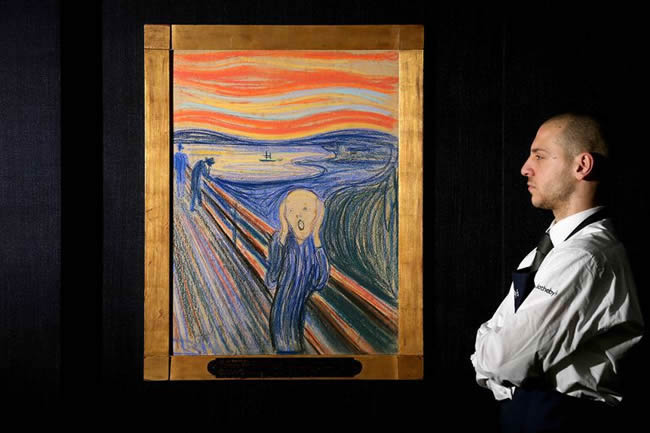
Although this fact is often forgotten, Edvard Munch intended The Scream to be part of a series, known as the Frieze of Life. The series dealt with emotional life, presumably applicable to all modern humans, though, in reality, it was applicable to Munch's favorite subject: himself. Frieze explored three different themes—Love, Anxiety, and Death—through sub-themes in each. The Scream was the final work of the Love theme and signified despair. According to Munch, despair was the ultimate outcome of love.
Androgynous, bald, pale, mouth open in a rictus of pain. The hands are obviously not dimming the "scream," which may or may not be internal. If it is the latter, clearly only the figure hears it or the man leaning on the railing in the background would have some kind of drawn response.
This figure could be no one or anyone; it may be Modern Man, it could be one of Munch's deceased parents, or it might be his mentally ill sister. Most likely it represents Munch himself or, rather, what was going on in his head. To be fair, he had a family history of poor physical and mental health and thought about these specters of doom frequently. He had father and mother issues, and he also had an acquired history of alcohol abuse. Combine the histories, and his psyche was very often in turmoil.
We do know that this scene had a real location, an overlook along a road traversing the Ekeberg hill, southeast of Oslo. From this vantage point, one can see Oslo, the Oslo Fjord, and the island of Hovedøya. Munch would have been familiar with the neighborhood because his younger sister, Laura, had been committed to an insane asylum there on February 29, 1892.
There are four colored versions, as well as a black and white lithographic stone Munch created in 1895.
I was walking along the road with two friends. The Sun was setting –
The Sky turned a bloody red
And I felt a whiff of Melancholy – I stood
Still, deathly tired – over the blue-black
Fjord and City hung Blood and Tongues of Fire
My Friends walked on – I remained behind
– shivering with Anxiety – I felt the great Scream in Nature
E.M.
This version has never been stolen or mishandled and was in a private collection from 1937 until it sold at auction on May 2, 2012, during the Impressionist & Modern Art Evening Sale at Sotheby's, New York. The hammer price with buyer's premium was a jaw-dropping $119,922,500 (USD).
All of the versions were done on cardboard and there was a reason for this. Munch used cardboard out of necessity at the beginning of his career; it was much less expensive than canvas. Later, when he could easily afford canvas, he often used cardboard instead just because he liked—and had grown accustomed to—its texture.
Munch is nearly always classified as a Symbolist, but make no mistake about The Scream: this is Expressionism in one of its most shining hours (true, there was no Expressionism the Movement in the 1890s, but bear with us).
Munch didn't lay down a faithful reproduction of the landscape surrounding the Oslo Fjord. The background figures are unidentifiable, and the central figure barely looks human. The turbulent, vivid sky may—but probably doesn't—represent Munch's memories of phenomenal sunsets a decade earlier, when ash from the 1883 eruption of Krakatoa circumnavigated the globe in the upper atmosphere.
What registers is a jarring combination of colors and mood. It makes us uncomfortable, just as the artist intended. The Scream shows us how Munch felt when he created it, and that is Expressionism in a nutshell.
Sources
Prideaux, Sue. Edvard Munch: Behind the Scream.
New Haven: Yale University Press, 2007.
Impressionist & Modern Art Evening Sale Lot Notes, Sotheby's, New York
