Was Leonardo a Vegetarian?

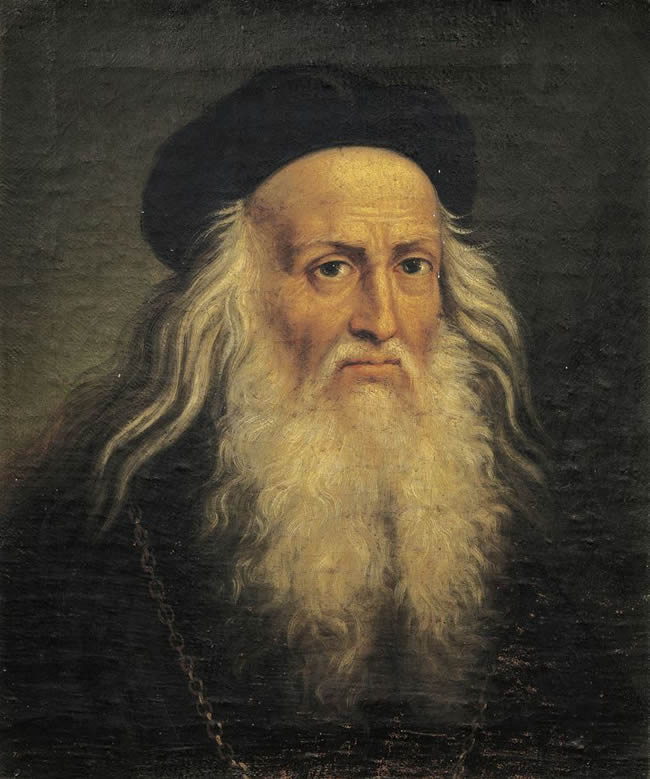
Increasingly, one sees Leonardo da Vinci's name trotted out during vegetarian v. omnivore debates. Leonardo has even been claimed by vegans (more on that later). But why? Why do we suppose we know the dietary habits of an inventor and painter who lived five centuries ago?
"Truly man is the king of beasts, for his brutality exceeds them. We live by the death of others. We are burial places! I have since an early age abjured the use of meat, and the time will come when men will look upon the murder of animals as they look upon the murder of man."
This, or some variation of it, is frequently used as proof that Leonardo was a vegetarian. The problem is that Leonardo never said these words. An author named Dmitry Sergeyevich Merezhkovsky (Russian, 1865-1941) wrote them for a work of historical fiction titled The Romance of Leonardo da Vinci. In point of fact, Merezhkovsky didn't even write the words for Leonardo, he put them in the (fictitious) diary of (real) apprentice Giovanni Antonio Boltraffio (ca. 1466-1516) as a quote from Leonardo.
The only thing this quote proves is that Merezhkovsky had heard of vegetarianism. It is not a valid argument for Leonardo having been meat-free.
Next up, we have one written reference to Leonardo's diet. For a bit of background, the writer was Italian explorer Andrea Corsali (1487-?), the gent who identified New Guinea, hypothesized on the existence of Australia, and was the first European to sketch the Southern Cross. Corsali worked for the Florentine Giuliano di Lorenzo de' Medici, one of three sons born to Lorenzo the Magnificent. The Medici dynasty hadn't become fabulously wealthy by ignoring new trade routes, so Giuliano financed Corsali's voyage on a Portuguese ship.
In a long letter to his patron (almost wholly filled with more important information), Corsali made an off-hand reference to Leonardo while describing followers of Hinduism:
"Alcuni gentili chiamati Guzzarati non si cibano dicosa alcuna che tenga sangue, ne fra essi loro consentono che si noccia adalcuna cosa animata, come it nostro Leonardo da Vinci."
In English:
"Certain infidels called Guzzarati are so gentle that they do not feed on anything which has blood, nor will they allow anyone to hurt any living thing, like our Leonardo da Vinci."
Did Corsali mean that Leonardo didn't eat meat, didn't allow harm to living creatures, or both? We don't know conclusively, because the artist, the explorer, and the banker weren't companions. Giuliano de'Medici (1479-1516) was Leonardo's patron for three years, from 1513 to the former's early death. It is unclear how well he and Leonardo knew each other. Not only did Giuliano view the artist as an employee (unlike Leonardo's former patron, Ludovico Sforza, Duke of Milan), the two men were of different generations.
As for Corsali, he appears to have known Leonardo through mutual Florentine connections. Though they were contemporaries, between the artist's time outside of Florence and the explorer's time outside of Italy, they did not have the opportunity to become close friends. Corsali may have been referencing Leonardo's habits through hearsay. Not that we will ever know--no one can say when or where Corsali died and Giuliano made no comment on the letter, seeing that he himself was dead by the time it was delivered.
Close to 70 separate authors have written biographies about Leonardo da Vinci. Of these, only two have mentioned his alleged vegetarianism: Serge Bramly (b. 1949) wrote "Leonardo loved animals so much, it seems, that he turned vegetarian" in Leonardo: Discovering the Life of Leonardo da Vinci, and Alessandro Vezzosi (b. 1950) referred to the artist as a vegetarian in Leonardo da Vinci.
Three other biographers cite the Corsali letter: Eugène Müntz (1845-1902) in Leonardo da Vinci: Artist, Thinker, and Man of Science; Edward McCurdy in The Mind of Leonardo da Vinci; and Jean Paul Richter in The Literary Works of Leonardo da Vinci.
If we use a deliberately low estimate of 60 biographies, then 8.33% of the authors spoke of Leonardo and vegetarianism. Take away the three writers who cited the Corsali letter, and we have a total of 3.34% (two biographers) who speak for themselves in saying that Leonardo was a vegetarian.
Let's start with what Leonardo didn't say. At no point did he write, and no source has ever quoted him saying, "I do not eat meat." Unfortunately, Leonardo--a man overflowing with talk of ideas and observations--hardly said anything personal about himself. On the matter of his diet, we can only glean a few inferences from his notebooks.
Of Bees: And many others will be deprived of their store and their food, and will be cruelly submerged and drowned by folks devoid of reason. Oh Justice of God! Why dost thou not wake and behold thy creatures thus ill used?
Of Sheep, Cows, Goats, etc: Endless multitudes of these will have their little children taken from them ripped open and flayed and most barbarously quartered.
That sounds terrible, doesn't it? Now consider the following:
Many offspring shall be snatched by cruel thrashing from the very arms of their mothers, and flung on the ground, and crushed.Seemingly, we just jumped from terrible to horrific--until we are informed that the last quote was about nuts and olives. You see, Leonardo's "Prophecies" weren't prophecies in the sense of Nostradamus or the Prophet Isaiah. They were the equivalent of an intellectual parlor game, in which two men matched wits. The object of the game was to describe the most ordinary, everyday events in such a way that they sounded like an impending Apocalypse.
This is in no way an indictment of veganism. However, it is impossible to claim that Leonardo da Vinci was a vegan.
Setting aside the fact that the term wasn't even coined until 1944, Leonardo ate cheese, eggs, and honey, and drank wine. More than that, all of the grains, fruits, and vegetables he ingested were grown using animal inputs (i.e.: manure) for soil fertility. Synthetic fertilizers would not be invented until far into the future, and would not be widely used until the second half of the 20th-century.
Additionally, we have to consider what he wore and what he used to create art. Leonardo did not have access to polyurethane footwear, for one thing. His brushes were animal products: sable or hog hairs attached to quills. He drew on vellum, which is the specially-tanned skin of calves, kids, and lambs. Sepia, a deep reddish brown pigment, comes from the ink sac of the cuttlefish. Even the simple paint, tempera, is made with eggs.
For all of these reasons, calling Leonardo a vegan--or a proto-vegan--is untrue.
In conclusion
Leonardo may have eaten an ovo-lacto vegetarian diet, although this has been pieced together from circumstantial evidence by a minority of experts. We lack conclusive proof and are unlikely to discover any after 500 years. If you wish to say he was a vegetarian, you are plausibly (although not definitively) correct, depending on your point of view. On the other hand, the speculation that Leonardo was a vegan is indisputably false. It is a deliberate deception for one to claim otherwise.
Sources
