Biography of Marcel Duchamp, Revolutionary of the Art World

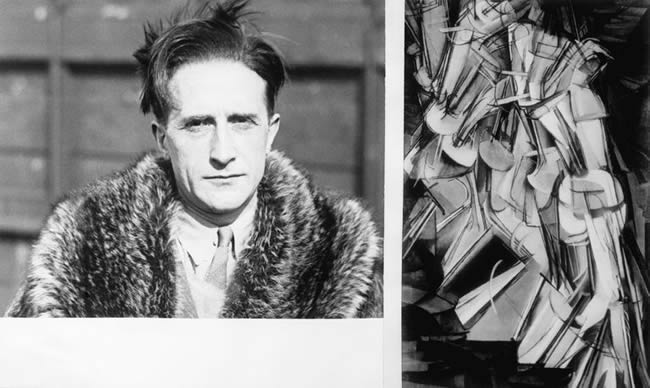
The French-American artist Marcel Duchamp (1887–1968) was an innovator, working across mediums such as painting, sculpture, collages, short films, body art, and found objects. Known as both a pioneer and a troublemaker, Duchamp is associated with several modern art movements, including Dadaism, Cubism, and Surrealism, and is credited for paving the way for Pop, Minimal, and Conceptual art.
Duchamp was born on July 28, 1887, the fourth child of seven born to Lucie and Eugene Duchamp. His father was a notary, but there was art in the family. Two of Duchamp's elder brothers were successful artists: the painter Jacques Villon (1875–1963) and the sculptor Raymond Duchamp-Villon (1876–1918). In addition, Duchamp's mother Lucie was an amateur artist and his grandfather was an engraver. When Duchamp came of age, Eugene willingly supported his son Marcel's career in art.
Duchamp made his first painting, Church in Blainville, at the age of 15, and enrolled in the Academie Jullian at Paris's École des Beaux-Arts. In a series of interviews published after his death, Duchamp is quoted as saying he couldn't remember any of the teachers he had, and that he spent the mornings playing billiards rather than going to the studio. He ended up flunking out after one year.
Duchamp's artistic life spanned several decades, during which he reinvented his art time and again, often offending critics' sensibilities along the way.
Duchamp spent most of those years alternating between Paris and New York. He mingled with the New York art scene, forging close friendships with American artist Man Ray, historian Jacques Martin Barzun, writer Henri-Pierre Roché, composer Edgar Varèse, and painters Francisco Picabia and Jean Crotti, among others.

Nude Descending a Staircase (No. 2) deeply offended the Cubists, because although it selected the color palette and form of Cubism, it added a reference to explicit perpetual motion and was seen as a dehumanized rendering of the female nude. The painting also created a big scandal at the 1913 New York Armory Show of Europe, after which Duchamp was heartily embraced by the New York crowd of Dadaists.
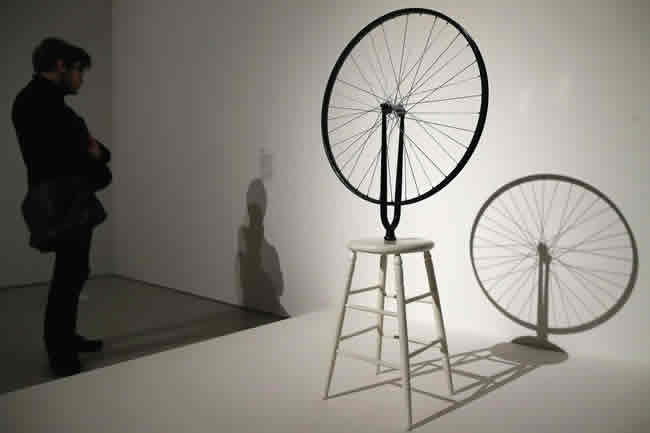
Bicycle Wheel (1913) was the first of Duchamp's "readymades": primarily manufactured objects with one or two minor tweaks to the form. In Bicycle Wheel, the fork and wheel of a bicycle are mounted on a stool.
The Bride Stripped Bare by her Bachelors, Even or The Large Glass (1915–1923) is a two-paned glass window with an image assembled out of lead foil, fuse wire, and dust. The upper panel illustrates an insect-like bride and the lower panel features the silhouettes of nine suitors, shooting their attention in her direction. The work broke during shipment in 1926; Duchamp repaired it about a decade later, saying, "It's a lot better with the breaks."
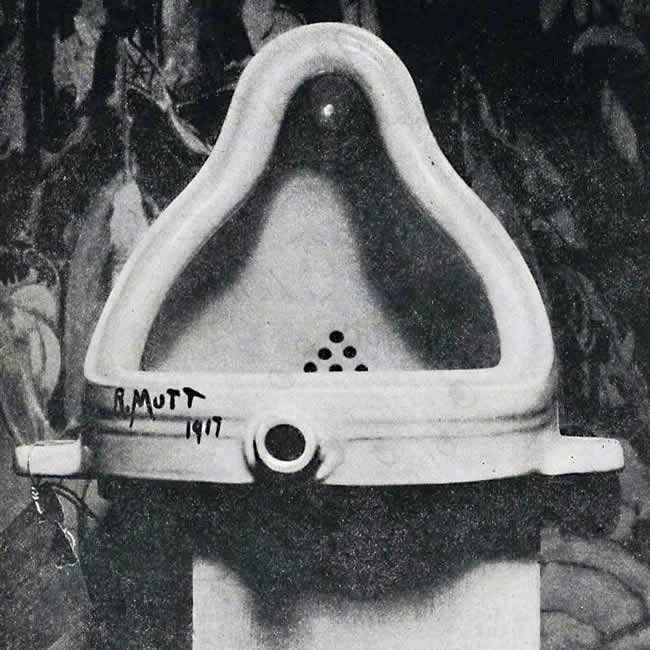
There is a rumor that The Fountain was not submitted to New York Independents Art Show by Duchamp, but rather by the Baroness Elsa von Freytag-Loringhoven, another Dada artist who played with gender and performance art and was among the more outrageous characters of the New York art scene.
While the original is long gone, there are 17 copies in different museums around the world, all assigned to Duchamp.
In 1923, Duchamp publicly renounced art, saying he would spend his life on chess. He was very good at chess and was on several French chess tournament teams. More or less secretly, however, he continued work from 1923 to 1946 under the name Rrose Sélavy. He also continued to produce readymades.
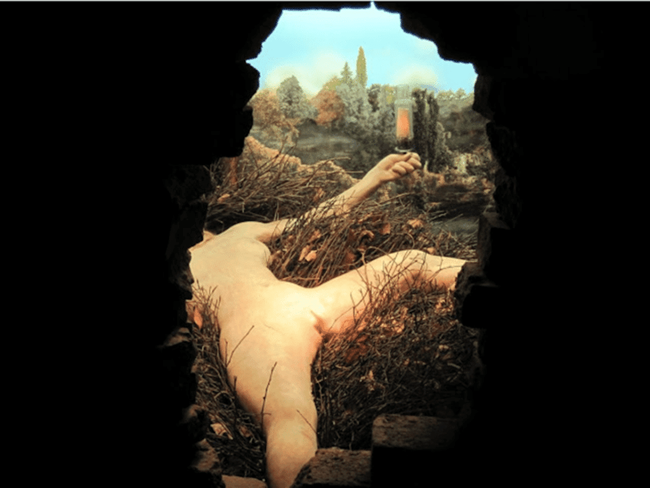
Etant donnes was Duchamp's last work. He made it in secret and wanted it shown only after his death. The work consists of a wooden door set in a brick frame. Inside the door are two peepholes, through which the viewer can see a deeply disturbing scene of a naked woman lying on a bed of twigs and holding a lit gaslight.
The Turkish artist Serkan Özkaya has suggested that the female figure in Etant donnes is, in some respects, a self-portrait of Duchamp, an idea also put forward in 2010 by artist Meeka Walsh in an essay in BorderCrossings.
Duchamp described his mother as distant and cold and indifferent, and he felt that she preferred his younger sisters to him, a preference that had a profound effect on his self-esteem. Although he presented himself as cool and detached in interviews, some biographers believe that his art reflects the strenuous efforts he made to deal with his silent rage and unmet need for erotic closeness.
Duchamp was married twice and had a long-term mistress. He also had a female alter ego, Rrose Sélavy, whose name translates to "Eros, such is life."
Marcel Duchamp died at his home in Neuilly-sur-Seine, France on October 2, 1968. He was buried in Rouen under the epitaph, "D'ailleurs, c'est toujours les autres qui meurent" ("Besides, it's always the others who die"). To this day, he is remembered as one of the great innovators in modern art. He invented new ways of thinking about what art can be and radically transformed ideas about culture.
