How to Select Colors for Pastel Painting

01
of 08
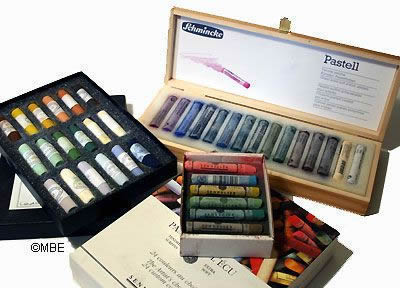
The quickest, and easiest way to get hold of a selection of pastels is to buy a ready-made set. All of the major artists' quality pastel manufacturers do sets. These range in size from ones as small as six sticks, to large wooded boxes covering their full range.
If you just want to try out pastels and get a feel for them, then get as small a set as possible. Or, better still, consider buying several sticks, each from a different manufacturer, so that you can experience the range of pastel softness/hardness available.
If you want to try some serious pastel painting, you'll need to get a set of between 30 and 40 pastels. If you already know that you intend to do mainly portraits or landscapes you can further refine this choice by buying a targeted pastel selection (starting with 10 midtone colors.
02
of 08
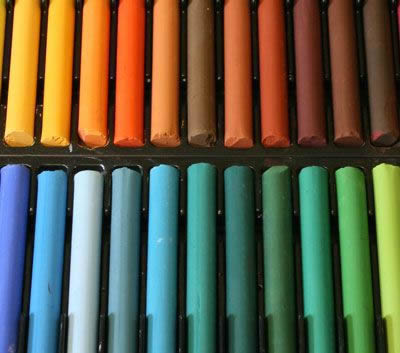
Among the skills and techniques you need to acquire for pastel painting are an feeling for how the pastel is going to behave on the paper, an understanding of how different tints work with each other, and most importantly, an innate understanding of color.
The most common mistake people make when starting out with pastels is to buy too many sticks and too many different colors. What you need to do is limit your selection to a range of warm and cool colors from each of the primaries and secondaries, plus a few browns (earth colors), a black, and a white.
Putting your own selection together is better than buying a ready-made set of pastels as this way you buy only what you need. Look at what is available either at your local art store or an online art supplies store, and let your subconscious select one example of each of the primaries and secondaries. (See Putting Your Own Set of Pastel Colors Together for suggested colors.)
You will also need to get a few light and dark versions of these colors to give you a range of painting tones. The ideal is to have three different tones across the colors (light, mid, and dark), but some, like yellow, only really come in light- and mid-tones.
03
of 08
The first step in putting together your own set of pastel colors is to select one of each of the following: warm red, cold red, orange, cold yellow, warm green, cold green, cold blue, warm blue, cold violet, and warm violet. But faced with so many options, how do you choose?
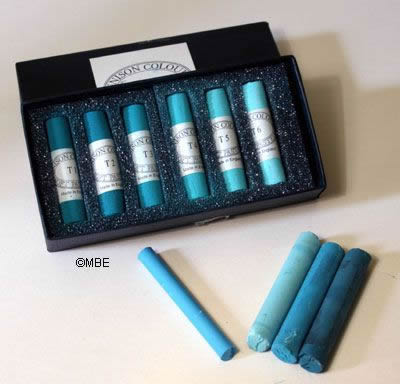
Well, pastels come in a range of tints. The majority of pastel manufacturers produce a basic tint and then a range of lighter and darker tints of this. These can be identified by the pastel's code number. Start by selecting the second or third darkest of any tint, in the colors listed above. This will provide you with a set of 10 mid-tone pastels.
The exceptions to this tine rule are Unison and Sennelier: Unison have created sets of harmonious pastels directly from pigments and grouped them together in sets. A general rule for Unison is that as number increases the pastel gets lighter, so for example Turquoise 1 is the darkest, Turquoise 6 is the lightest. For your initial selection, pick the second or third darkest pastel in a group. Similarly, Sennelier typically come in groups of five to eight tints; again go for the second or third darkest.
Schmincke identify their 'pure' colors with a D at the end of the code, for example Cobalt Turquoise is 650D. Rembrandt use a '.5' at the end of the code to identify the 'pure' color, for example Turquoise 522.5. The pure color from Daler-Rowney is typically tint #6, and Winsor and Newton as tint #4 (out of 5).
If you're unsure about exactly which colors and tints to get, here are my suggestions.
04
of 08
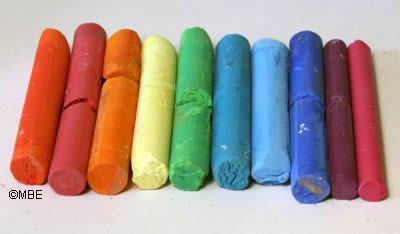
Your initial 10 pastels will provide you with a set of mid tones (warm red, cold red, orange, cold yellow, warm green, cold green, cold blue, warm blue, cold violet, and warm violet). Remember, you want a selection which is relatively harmonious and representative of the subjects you will paint.
It is best if you make the choice yourself, but if you're unsure, here are my suggestions:
Once you have these 10 basic pastels, you'll have your mid-tone collection. Now you need to expand the set to include dark and light tones.
05
of 08
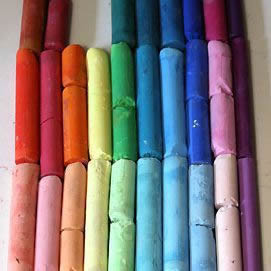
Pastel manufacturers generally create lighter tints adding kaolin (china clay) or chalk to the pigment mix; darker shades are created by adding 'black' pigments such as PBk6 (carbon black). You can get a light and dark tone to complement each of the 10 you have selected for your mid-tone set, but some aren't absolutely necessary.
Don't bother with dark versions of the cool yellow and orange (dark yellows tend to be a dark green-black) and the mid-tone orange is probably as intense as you will need for now. For the dark tone, take the darkest pastel from the same group as the mid-tone. For the light, take the lightest, or second lightest from the group.
This is what I recommend:
You should now have 28 pastel sticks. Next, you need to get some earth colors.
06
of 08
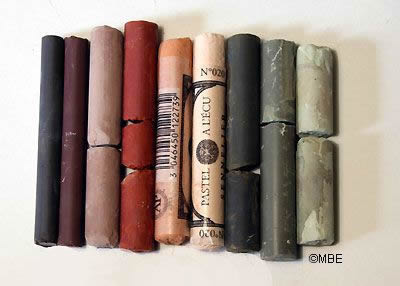
At the very minimum you need a warm and a cold earth-brown, along with a lighter and darker tint. My suggestion would be a yellow or gold ocher and a burnt sienna. If you want a slightly larger range of earth colors, then also consider a raw umber and a Caput Moruum, Indian red, or mars violet.
Now there's just black and white to consider.
07
of 08
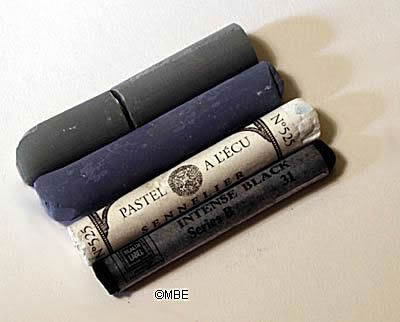
You probably won't use a black pastel very often as it's a very intense, almost selfish color, but in those cases where the dark tint is just not intense enough, a black will give that final touch. Several manufacturers offer an 'intense' or 'serious' black which are ideal.
White will be more useful, especially if you have chosen the second lightest tints of the mid-tone colors for your set. If you are going to be using the white mainly for highlights, consider buying one from Unison, Sennelier, or best of all Schmincke. These tend to be softer and easier to apply to an almost finished pastel painting.
Lastly get a couple of gray pastel sticks. Rather than taking a neutral gray, take a warm (Davy's gray or Mouse Gray) and cold (Payne's gray or Blue gray) color.
08
of 08
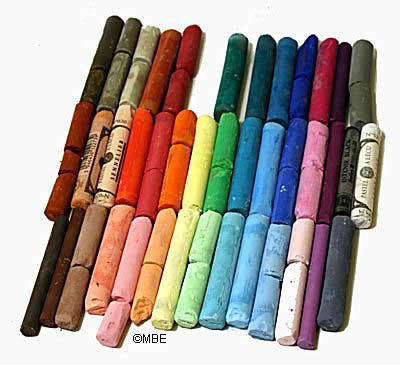
The photo above shows you the complete set of pastel colors selected by the method explained in this step-by-step. The next thing to do is to get painting with them! (See Basic Techniques for Pastels.)
